WELLNESS INSIDER

Home > Pain Science > Back Pain

Licensed Physical Therapist Goes Public: "85% of Back Pain Patients Are Being Treated for the Wrong Tissue"

DPT with 28 years clinical experience exposes the $80 billion back pain machine — and reveals the 15-minute home method that ended her own crippling sciatica after $14,000 in failed treatments. No pills. No injections. Works even when nothing else has.

Mon. 6. April, 2026 | 11:11 am PST - 251.328 👁

By Rachel Thornton, DPT Licensed Physical Therapist — 28 years clinical experience Verified Purchaser

If you've spent thousands on chiropractic, pills, or injections and your back pain or sciatica still wakes you up at 3 AM — stop and read this before you book another appointment.


What I'm about to tell you will make every chiropractor, pain clinic, and spine specialist in America uncomfortable.
 

It cost me my career assumptions, $14,000, and two years of my life with my family. And once you see it, you cannot unsee it.

For 28 years, I stood on one side of the treatment table. I wrote rehab programs. Demonstrated core exercises. Positioned patients on traction machines and told them to breathe through the stretch.


I kept a plastic spine model on my desk and used it to explain disc compression to patients who were scared — patients looking for someone who could tell them why their body was failing. 


I referred to surgeons when physical therapy "wasn't enough." I signed off on treatment plans I believed in completely.

I was certain I understood chronic back pain.


I was wrong about the one thing that mattered most. And so is almost every specialist you've ever paid.

The pain arrived at 54 and built its life inside mine.

It began as a deep ache across my lower back — the kind that makes you rearrange pillows and tell yourself it's nothing. Within weeks it had edges. 


Sharp catches when I bent. A burning line from my lumbar spine through my left hip, down the back of my thigh, into my calf. I knew the pathway — the sciatic nerve, the longest nerve in the body. I'd traced it on anatomy charts a thousand times. I'd never felt it light up inside my own body like a stripped wire.


By the second month, the pain had restructured my life. I stopped sitting in chairs without armrests. I mapped every outing by how much walking it required. I declined dinner invitations because the wrong chair could ruin a weekend. I stopped exercising. Stopped gardening. Stopped moving any more than I had to.
 

My husband David never said a word about what was happening. That was the worst part.

He started absorbing tasks without being asked. 

The groceries. 

The laundry. 

Anything heavier than a plate. 

He moved the heavy pots to a lower shelf. 

He started unlocking the car before I reached it so I wouldn’t have to twist while pulling the handle. He reorganized the kitchen so everything I used daily was between hip and shoulder height.


No complaints. No sighs. He just quietly rebuilt our home around my limitations. And each accommodation landed like a verdict: this is who you are now.


One morning, our ten-year-old Jake stood in the doorway watching me try to put on my shoes — the slow, careful bend, arms braced on the mattress, lowering toward the laces like defusing a bomb. He watched the whole performance with his backpack on.


Then he said:


Mom, are you going to be like this forever?”


I told him no. I told him I was working on it.


That night, after he and David were asleep, I sat in the kitchen alone and cried. Because the honest answer was: I don’t know.
 

Two Years. $14,000. Four Failed Treatments. And the Same Hidden Reason Each One Failed.

The cruelest part of chronic pain isn't the pain. It's the hope cycle. You hear about a treatment. You let yourself believe. You spend the money. You feel better for a day, a week, maybe two. Then the pain returns — same spots, same intensity — and you have to start hoping again.


I went through that cycle four times. And what I understand now, after everything, is that every single treatment failed for the same reason. Not because the clinicians were incompetent. Because the system pointed them — and me — at the wrong tissue.


Stay with me. Because if you've tried even one of the four things I'm about to walk you through — and you're still in pain — what I discovered on my living room floor at 11 PM on a Tuesday will change how you think about your body for the rest of your life.


Round one: my own physical therapy protocol. Six weeks of core strengthening and stabilization — the program I'd prescribed to hundreds of patients. The sciatica got worse. I was building armor around a fire.


Round two: chiropractic. Twice a week. $65 per session. $520 a month. Each adjustment was technically correct — the vertebrae were realigned. For about 45 minutes, my back felt open. Then, on the drive home, the muscles pulled everything right back. Every time. The same muscles. The same pull.


David stopped asking how the appointment went after month three. He'd be in the kitchen when I came through the door, and he'd look at my face, and he'd know. After a while, he just started having the heating pad plugged in and ready on the couch. No words. Just the pad, waiting.


I was paying $520 a month for adjustments that the muscles undid before I reached my driveway. $6,240 a year. And it never occurred to me — or to the chiropractor — to ask why the muscles kept overriding the correction. We just kept adjusting. The system doesn't ask why the adjustment doesn't hold. The system books the next appointment.


Round three: medication. Ibuprofen, 1,800mg daily. It turned the volume down. The source of the signal remained untouched. After four months: bloating, acid reflux, nausea. My doctor called it "the trade-off" — twenty-eight years in medicine, I'd used that exact phrase with patients. I never heard what it sounded like from the other side.


Round four: cortisone injection. $800 after insurance. Eleven days of real relief — the kind that makes you remember who you used to be. Then, day twelve, I bent to pick up Jake's soccer cleats from the hallway. The burning shot through my hip and down my leg like it had never left.


$14,000. Two years. Every treatment aimed at the spine. Not one had addressed what was actually generating the compression. And the system that charged me $14,000 had no reason to look deeper — because looking deeper leads to a solution, and solutions end the billing cycle.
 

11 PM. Tuesday. February. The Moment I Realized Every Specialist in America Has Been Treating the Wrong Tissue.

It was a Tuesday in February. I was on the living room carpet at 11 PM — the floor was the only surface that didn’t make things worse. David had gone to bed. The house was quiet.


I was reading research journals. Not patient summaries. The actual published studies. I’d stopped asking “what’s the best treatment for back pain?” and started asking: “Why does nothing work?”


The answer, when I found it, was so simple I felt something between relief and rage.


Every specialist I'd seen — every chiropractor, every orthopedic, every pain doctor — had examined the spine itself. The vertebrae. The discs. The nerves coming out of it.

Not one had examined the tissue that was actually crushing the spine from both sides.

Not one.

And the research has been published — in peer-reviewed medical journals — for years.


The paraspinal muscles — the deep muscles running along both sides of the vertebral column — are supposed to support and stabilize the spine. But in chronic pain patients, they go into guarding mode. 


They contract to protect the area. It's a survival response — automatic, hardwired. For acute pain, it works perfectly. The muscles lock down, you stop moving, the injury heals.
 

The problem: they don’t unlock.

After weeks and months of guarding, the contraction becomes permanent. The muscles harden. They develop trigger points — molecular formations that lock fibers into chronic contraction the muscle cannot break on its own. 


A 2024 study from Shandong University, published in Anesthesiology, identified the exact molecular mechanism for the first time.

Think of it this way: the muscles around your spine have clenched into fists.

Not supporting fists. Crushing fists. Every locked fiber pulling the vertebrae closer together. Squeezing the discs. 


Narrowing the channels where the nerves exit. Your spine isn't just degenerating from age. 


It's being crushed from both sides by the muscles that were supposed to protect it.


That’s why the chiropractor’s adjustments didn’t hold — he was repositioning bones between clenched fists. The fists pulled them right back.


That’s why the cortisone faded in eleven days — it reduced swelling around the spine, but the fists were still squeezing.
That’s why stretching made things worse — I was pulling on muscles that were already clenched.


That’s why ibuprofen only turned the volume down — the fists were still compressing the nerve, every hour of every day.


The research says up to 85% of patients at pain clinics have trigger points as their primary pain generator. Not discs. Not bone. Muscle. The tissue nobody was treating.


I lay on that carpet and thought about every patient I’d ever treated. Every one I’d sent through the same cycle — exercises, adjustments, injections, referrals — treating the spine while the fists kept crushing it.
 

What I felt — and what I need you to understand about waiting

I lay there until 2 AM. 


Not reading anymore. Just processing.


Two years. $14,000. And the answer had been in the muscles the entire time. Not hidden. Not controversial. Published in research journals that anyone with a library card could access. 


The 85% statistic alone should have changed how every specialist in the country approaches chronic back pain. But there’s no billing code for releasing muscle fists. No imaging order. No injection protocol. No surgical procedure. You can’t build a $100 billion industry around teaching patients to release their own muscles.


The rage faded. What replaced it was urgency — because I understood something else about those clenched fists.
They don’t release on their own. The contraction is self-sustaining. The locked fibers choke off their own blood supply, which starves them of oxygen, which causes them to contract harder. The fists tighten on their own.


And every week they stay clenched, the damage escalates.
Your body starts compensating — shifting weight, tightening other muscles, guarding movements. Those compensations create new trigger points in new muscles. New fists. The pattern expands.


The connective tissue around the fists — the fascia wrapping every muscle — stiffens. Layers that should slide freely adhere. The fists get structural reinforcement.


And eventually, the nervous system itself changes. The Cleveland Clinic describes it as central sensitization — the brain learns to expect pain and starts amplifying signals. Normal touch becomes uncomfortable. Mild movement becomes threatening. The pain leaves the muscles and takes up residence in the wiring of your nervous system.


That’s what “waiting it out” actually looks like. 

 

Not recovery. 

 

Escalation. 


It looks like realizing one morning that you haven’t hugged your partner — really hugged them, full body, without bracing — in six months. It looks like your world shrinking so gradually you don’t notice until you’re living between three rooms and a car seat. It looks like a ten-year-old asking if this is forever — and not knowing the answer.


Waiting isn’t neutral. 


Waiting is the fists clenching tighter.
 

What has to happen to open the fists

I went through every failed treatment and asked one question:

does this open the fists?


Stretching pulls the arm. 

Fists stay closed. 

Chiropractic adjusts the bones between the fists. 

Fists pull them back. 

Ibuprofen dims the pain signal. 

Fists stay closed. 

Cortisone reduces swelling around the spine. 

Fists stay closed.


Then I asked: what would actually unclench them?


The research pointed to three things — working simultaneously. 


Remove any one and the fists re-lock.


1. Deep, rotating pressure applied directly into the paraspinal muscles.


Not surface rubbing. Not vibration. Not stretching. The kind of pressure a trained shiatsu therapist applies with their thumbs — kneading directly into the locked fibers, disrupting the molecular contraction, forcing the clenched tissue to release. Research from McMaster University showed just 10 minutes of this kind of pressure reduced inflammatory cytokines at the gene-expression level and triggered new mitochondrial growth in the muscle cells. The lead researcher said it may work through the same mechanism as ibuprofen — without touching your stomach, your liver, or your brain.


2. Sustained heat delivered into the muscle during the pressure.


Heat opens blood vessels inside the clenched tissue, flooding oxygen into fibers that have been suffocating. But it does something else most people miss: it signals safety to the nervous system. The guarding reflex that started this whole cycle is automatic and unconscious. It only releases when the body receives a sustained signal that the threat is over. Without heat, the fists loosen under pressure but re-lock within hours. With heat, the guarding stands down. The spine naturally decompresses as the crushing force drops.


3. and this is the one that explains why everything else only lasts an hour: you need to switch off the guarding reflex itself.


The reason the muscles clenched in the first place is a protective reflex from your nervous system. That reflex is unconscious. Automatic. And it's still running — months or years after the original trigger. The specific combination of deep pressure and sustained heat activates the vagus nerve — the body's master switch between fight-or-flight and rest-and-heal. When that switch flips, the guarding reflex releases. Not for an hour. The nervous system learns to stand down.


The University of Miami School of Medicine and Duke University documented the shift: cortisol drops 31%. Serotonin rises 28%. Dopamine rises 31%. The muscles don’t just release — they stop re-clenching. This is the difference between temporary relief and lasting change. This is the mechanism that every massage, every adjustment, every pill was missing. Not because it’s complicated. Because it requires all three layers working together — and no single treatment delivers that.


A professional who delivers all three charges $80 to $150 per session. The research says multiple times per week. That’s $640-$1,200 a month. $8,000-$15,600 a year.
 

The science is right. The economics are impossible. And in that gap — between what your muscles need and what you can afford — is where millions of people stay trapped.


What I found — and why it took me two weeks to believe it.
 

After 28 years in clinical practice, my reflex when I see “breakthrough” is to close the tab. I’ve watched too many patients waste money on devices that buzz and do nothing.
So when Christine — a fellow PT I’ve trusted for fifteen years — told me about a shiatsu device she’d been recommending to patients with myofascial pain, my first response was polite skepticism.


Then I looked at the mechanism. And the skepticism paused.
Four kneading nodes that rotate in alternating directions — not simple circles, but multi-dimensional movement that pushes inward, rolls upward, and changes angle. The exact motion I’ve watched shiatsu therapists perform with their thumbs for three decades. Dual-zone heat spanning the full lumbar and thoracic region — not surface warmth, but therapeutic heat that reaches the deep muscle layer. And a design built for daily use at home: 15-minute auto-shutoff, three intensity levels, quiet enough to use while someone sleeps next to you.


It wasn’t claiming to decompress the spine. It was doing the three things the research said were necessary to open the fists — deep kneading pressure, sustained heat, and parasympathetic nerve activation — in one device that costs less than a single professional massage.
 

The Device Christine Showed Me: The Orthevia OrthoRelief Pro — And the NeuroRelease™ System Inside It That Finally Made Everything Click.

The name made me pause. “Neuro” — because the system targets not just the muscle, but the nervous system patterns that keep the muscles locked. “Release” — because that’s the singular objective: opening the fists


The three layers they’d named:

1. 4D Paraspinal Kneading:

— the multi-dimensional nodes reaching the deep muscle layer where the fists live. Engineered to maintain full pressure under body weight — the critical difference from budget devices, where the motors stall the moment you lean in and you lose depth exactly when you need it most.

2. Dual-Zone Thermal Penetration:

— two independent heat zones with two levels of intensity. Thermal imaging shows the tissue shift from restricted blue to restored red within minutes — blood flow returning to muscles that have been suffocating.

3. Parasympathetic Nerve Activation:

 — the deep pressure combined with sustained heat triggers the vagus nerve during every session. The guarding reflex that locked the muscles releases. The fists don’t just open — they stop re-clenching. This is the third layer that separates the NeuroRelease System from every other device on the market. Without it, you get an hour of relief. With it, the relief holds.

I waited two weeks. I re-read the McMaster study. I thought about the fists inside my own back — the ones that $14,000 hadn't opened.


But something else caught my attention. The contoured shape and node positioning meant the device could be placed behind the neck, between the shoulder blades, against the upper back — anywhere the paraspinal and postural muscles run. 


And as a PT, I knew something most people don't: the same fists that form in the lower back form everywhere chronic tension lives. The trapezius muscles in your shoulders. The cervical muscles in your neck. The thoracic muscles between your shoulder blades. Trigger points don't discriminate.


Twenty-eight years of leaning over treatment tables had given me a concrete block between my shoulder blades and a neck that hadn't turned freely in a decade. I'd accepted both as the cost of my career. I'd never connected them to the same mechanism.


This wasn't just a back device. This was a neuromuscular release system for anywhere the fists had formed. Then I ordered one.
 

The First 15 Minutes On My Couch — And the Four Words From My Husband That Made Me Cry


I placed it behind my lower back on the couch. Pressed the button.


The nodes engaged. Four points of rotating pressure, kneading into the muscles on either side of my spine. Deep. Deliberate. Not diffuse like a vibration pad. Specific. The kind of pressure that makes you exhale because your body recognizes it as something real.


Then the heat.


Not sharp. Not surface. A slow warmth that sinks. Past the skin. Past the superficial layer. Into the tissue where the fists live.
I felt the moment it reached the paraspinal muscles around L4 and L5. The ones that had been clenching around those vertebrae for two years. The kneading pressed into the contraction. The heat softened around it.


And the fists began to open.


Not all at once. Not dramatically. One finger at a time — the way tension leaves when the body finally believes it’s safe.


Fifteen minutes. The auto-shutoff clicked. The room was so quiet I could hear David turning a page across the room. He hadn’t heard a thing.


When I stood up, I stood straight. My body did it on its own. No guarding. No bracing.


David looked up. Four words: “There you are.”


Not “you look better.” Not “how do you feel.” There you are. As if I’d been gone for two years. As if the person he married had just walked back into the room.

What Happened Over the Next 8 Weeks — Day by Day, From a Skeptical PT Who Tracked Every Change

Day 1. 

That evening, I stood straighter. The burning down my left leg was quieter by bedtime. I fell asleep without repositioning.


Day 3. 

The constant ache across my lower back — two years of background noise — dropped. I bent to pick up Jake's backpack without planning the movement. Just bent.


End of week one. 

Jake came home from school, ran past me, stopped, turned around. "Mom, you're not doing the face anymore." The involuntary grimace — gone. I hadn't noticed. He had.


Week two. 

Made dinner standing for 45 minutes. Loaded the dishwasher in one trip. Carried the grocery bags in myself. David watched me unload the car. He didn't offer to help. Not because he didn't care — because he could see I didn't need it. That shift — from managed to capable — was quieter than any conversation but louder than anything we could have said.


Week three. 

I was sleeping through the night — truly through it, not the fragmented half-sleep of a body always bracing. The afternoon brain fog was lifting. My mood was lighter. I wasn't just in less pain. I was more present. My nervous system had been stuck in fight-or-flight for two years. The 15 minutes of deep pressure with heat each evening was flipping the switch — and I was living it.


Week four. 

Canceled chiropractic. The adjustments had been correct — but the fists had overridden them every time. Now the fists were open. The muscles had stopped pulling. My body was holding its own structure.


Week four, continued. 

With my lower back finally quiet, I started noticing the concrete slab between my shoulder blades. The cervical tension that made me rotate my whole torso to check blind spots. The headaches that started at the base of my skull every afternoon. 


Twenty-eight years of leaning over patients. I'd assumed it was just the cost of the career.

I repositioned the device higher, between my shoulder blades. Same mechanism. Same fists. Different address. Within a week, the concrete was cracking. I turned my head to check my blind spot — just turned it — and realized I hadn't done that in years. The afternoon headaches stopped. Not gradually. They just stopped coming.


Week five. 

Jake sat next to me on the couch. Without thinking, I reached over, pulled him against my side, and squeezed. The twist, the reach, the squeeze — the exact motion I'd been avoiding for months. My body just did it. He leaned in. Said nothing. That silence said everything.


Eight weeks. The soccer game.


Saturday afternoon. Jake’s team. I almost didn’t go — habit, not pain. Two years of metal bleachers had trained me to avoid them.
I sat for the full game. Didn’t shift. Didn’t brace. Didn’t count minutes.
When his team scored, I stood up. Fast. No catch. No grab. Just up.
After the game he ran to me, grass-stained and grinning. “Mom, you jumped.”


I drove home with the windows down. Jake in the back seat talking about the goal. David’s hand resting on mine. And I realized the feeling in my chest wasn’t happiness — it was something more fundamental.


The absence of dread. The constant anticipation of pain that had colored every moment for two years — gone. In its place: just Saturday. Just a drive home from a soccer game with my family.
That’s what opening the fists gave me. Not a miracle. Just Saturday.
 

I need to talk to you directly now.


If you’re reading this on your couch right now — shifting for the third time in ten minutes, with that familiar tightness across your lower back or that burning running down your leg — I know exactly what you’re living with. I know the morning negotiations with your own body. I know the mental math you do before every outing — can I sit that long? Will there be a chair? Can I get through it without anyone noticing? I know the guilt of watching someone you love silently rearrange their life around your limitations.


And if it’s not your lower back — if it’s the concrete block between your shoulder blades that no amount of rolling or stretching has ever cracked, or the neck stiffness that’s been building for years until you can’t turn your head without turning your whole body, or the headaches that start at the base of your skull every afternoon — it’s the same mechanism. The same fists. The same locked trigger points in different muscles. The same crushing force that nobody in the treatment chain is examining.


You’re not broken. Your muscles are clenching — in your lower back, your neck, your shoulders, wherever chronic tension has taken hold — and nobody you’ve been paying has a financial reason to tell you that.


But you can open those fists. At home. In 15 minutes. Every evening. Without another appointment, another copay, another injection, another bottle of Advil.


And if it doesn’t work — you pay nothing. The guarantee is absolute.
 

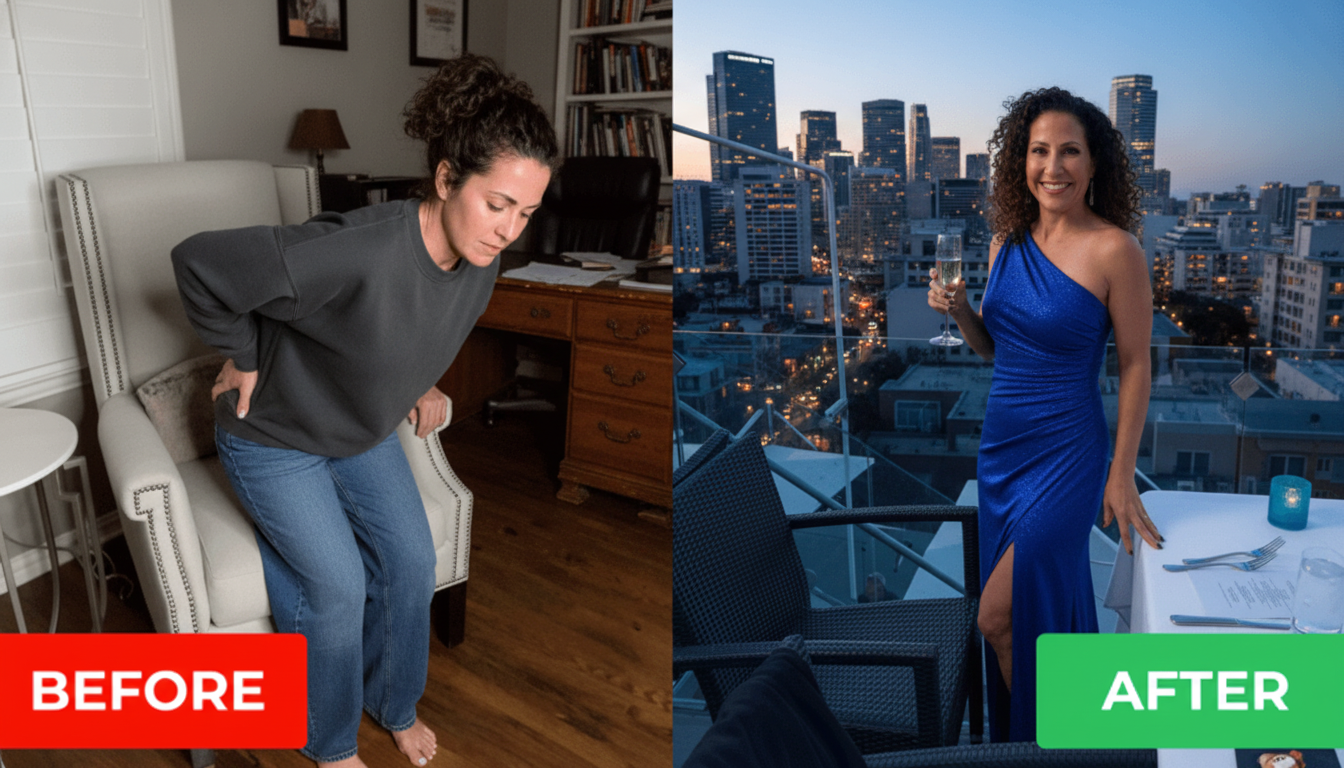
Before:

Sciatica down my leg — couldn’t sit through a meal

Mornings were a negotiation with my own body

$520/month chiropractic — wore off on the drive home

1,800mg ibuprofen daily — stomach collapsing

Neck wouldn’t turn — checked blind spots with my whole torso 

 Concrete block between shoulder blades — 28 years of leaning over patients

 Stopped exercising, socializing, living

 Jake asked if I was going to be like this forever

After four weeks with the NeuroRelease™ System:

Sciatica quiet — sit through meals, movies, drives without thinking

Out of bed in one motion — no strategy, no wincing

Canceled chiropractic — spine holds alignment now that the fists are open

No ibuprofen in three weeks — stomach recovering

Neck turns freely — checking blind spots like a normal person again

Shoulder tension cracking — afternoon headaches stopped

Back at the gym, walking daily, hugging my kid without bracing

Jake said: “You’re not doing the face anymore”

What does Saturday cost?


I spent $14,000 over two years on treatments that never reached the fists.


Professional deep-tissue massage: $80-$150/session. Research frequency: twice weekly. Annual cost: $8,000-$15,600.


The Orthevia OrthoRelief Pro with the NeuroRelease™ System retails for $364.95.


Right now, it’s 60% off — $129.95.


That’s less than a single massage. Less than one chiropractic session. Less than one copay at the pain clinic.
 

For a device that delivered “there you are” from a husband who’d been waiting two years for his wife to come back. That delivered “you’re not doing the face anymore” from a ten-year-old who’d been watching his mother disappear. 


That delivered “Mom, you jumped” from a kid at a soccer game who’d forgotten what his mother looked like when she wasn’t in pain.


That’s what $139.95 buys. Not a massage pillow. Saturday.

FOR A LIMITED TIME:

60% OFF + WE PAY SHIPPING

Limited Offer — Current Stock Only

ORTHEVIA OrthoRelief Pro

with NeuroRelease™ System


The only device that delivers all three therapies simultaneously — deep kneading, dual-zone heat penetration, and parasympathetic nerve activation — for a fraction of the cost of a single month of regular treatment.


     $ 324.95      

          $ 129.95           60 % OFF TODAY

BUY NOW

30-Day Money-Back Guarantee — No Questions


Use it daily for 30 days. Feel the kneading press into the muscles that have been clenching around your spine. Feel the heat reach the layer where the fists live. Notice what changes — in your mornings, your sleep, the way you stand, the way you bend, the way you reach for the people you love.


If after 30 days you don’t feel a meaningful difference — full refund. Prepaid label. 48 hours. No forms. No conditions.
 

BUY NOW

P.S. — The guarantee means you risk nothing except thirty days of finally addressing the tissue that’s actually causing the compression. If the NeuroRelease System doesn’t change your mornings, your sleep, and the weight you carry through every ordinary moment — every dollar back. After what I’ve lived, and what I now understand about the fists that were crushing my own spine for two years, I don’t think you’ll send it back.


P.P.S. — Last Saturday. Jake scored. I jumped. No catch. No brace. Just up. He ran to me afterward and said: “Mom, you jumped.” Two words that carried two years — every morning I’d struggled through, every dinner I’d shifted through, every Saturday I’d missed. I want you to have your jump. I want you to have your Saturdays back.


P.P.P.S.The 60% discount applies to current inventory only. Trigger points are self-sustaining — the molecular contraction feeds itself. The fists clench tighter on their own. The fascia stiffens. The nervous system adapts. What takes four weeks to release today takes months a year from now. The fists don’t wait. Neither should you.

BUY NOW

Dr. Rachel Thornton Rating: 4.9 Stars


Don't hate me — but I did take off a fraction of a star, and here's why. The OrthoRelief Pro works almost TOO well.

I think that's exactly why people who try the OrthoRelief Pro say this device is loved by thousands of satisfied customers. See what they have to say.

OrthoRelief Pro with the NeuroRelease™ System is now 60% off and selling out fast.

You already deserve to live without pain… So doesn't it make sense to claim yours now before someone else takes your spot?

BUY NOW

A breakthrough technology is currently making waves — it eliminates neck, shoulder and back pain in just 15 minutes a day, without medication, injections, or invasive procedures.

Hillary Weber

Back pain gone in just a few days


Reviewed in the United States on November 17, 2025

Verified Purchase

"I had suffered from chronic neck and shoulder tension for years, and this is the first product that gave me noticeable relief after just one session. I've noticed how much my posture has improved and how the deep stiffness in my upper back has finally loosened. A real breakthrough for my daily routine — I can move freely again."

Michael Macht

This device has changed everything for me!


Reviewed in the United States on November 24, 2025

Verified Purchase

"I stand on my feet all day at work, and by evening my knees and back are always completely wrecked. Since I started using the OrthoRelief Pro, the pressure and discomfort has noticeably reduced. I use it while watching TV in the evenings — it's become a firm part of my daily routine. Absolutely worth every penny."

Anna Wagner

Finally normal again — after years of pain!

Reviewed in the United States on April 14, 2026

Verified Purchase

"After years of pain shooting down my legs I was constantly struggling with tension and stiffness. I tried the OrthoRelief Pro and I can't believe the difference. It's so easy to use, incredibly effective — my whole body feels lighter, pain-free, and finally normal again."

ORDER NOW

Add a comment...

sarah mitchell

Has anyone actually tried this for sciatica? I've been dealing with it for months and nothing seems to help for more than a day...

Like    ·       Reply ·

4 · 39 min

lisa kowalski

Yes, Sarah! I had sciatica shooting down my left leg for over a year. Three weeks with the OrthoRelief and the burning is almost completely gone. The heat combined with the kneading actually reaches deep — not like those cheap vibrating pads.

Like    ·       Reply ·

7 · 16 min

julia schwarz

ER nurse here. 12-hour shifts destroyed my neck and upper back. My husband got me this after I read the article. I was skeptical — I've been burned by gadgets before. But the 30-day guarantee made it risk-free. Two weeks in and the concrete block between my shoulder blades is finally cracking. I use it every night on the couch before bed.

Like    ·       Reply ·

4 · 51 min

thomas klein

Honest question — how is this different from the $70 ones on Amazon? Serious ask before I spend the money.

Like    ·       Reply ·

1 · 1h

markus berg

Thomas, I've owned three of those. The motors stall the second you lean your full weight in. You lose all the pressure exactly when you need it most. This one holds deep pressure AND has real heat that penetrates. Night and day difference. I'm 5 months in, still going strong daily.

Like    ·       Reply ·

2 · 25 min

robert chen

My wife convinced me to try it. I ordered fully expecting to return it — I've wasted money on every gadget the internet has ever told me about. Three weeks later: sciatica 80% quieter, haven't touched the Advil bottle, sleeping through the night. I was wrong. Keeping it.

Like    ·       Reply ·

6 · 1h

nancy peterson

@Robert same story here! The 60% off deal with the money-back guarantee made it easy to just try it. Now it's the one thing in my daily routine I won't skip. Just secured mine before they sell out.

Like    ·       Reply ·

2 · 2h

christian meier

I'm 71. My daughter ordered this for my birthday after I'd been struggling to get out of my chair without holding the armrest. Two weeks in — I just got up. No grab. No strategy. I stopped expecting things to get better at my age. This got better.

Like    ·       Reply ·

3 · 1h

laura henderson

Quick question about the cable — how long is it? Can I use it comfortably on the couch without sitting right next to the outlet?

Like    ·       Reply ·

2 · 2h

helga schmidt

Hey Laura, the cable is long enough for normal couch distances. And since it's plug-in, the power never drops mid-session unlike battery ones. Full pressure the entire time — that consistency is actually what makes it work.

Like    ·       Reply ·

5 · 1h

greg foster

I'm on my feet cutting hair for 9 hours straight every day. By closing time my lower back and legs feel like they're on fire. Since I started using the OrthoRelief for 15 minutes right after my shift, the stabbing pain in my legs is basically gone. Total game changer for anyone standing all day.

Like    ·       Reply ·

1 · 3h

brian kim

Quick question — how loud is this thing? I'd love to use it in the evenings but my wife reads next to me and I don't want to bother her.

Like    ·       Reply ·

1 · 3h

tom parker

No worries at all Brian — it's whisper quiet. Just a low, steady hum. My wife actually falls asleep beside me while I use it. 😄

Like    ·       Reply ·

3 · 2h

rachel wood

I don't even use this just for pain anymore — it's become my daily unwinding ritual. After a brutal day at the office the heat just melts everything out of my neck and shoulders. It completely resets my nervous system. Feels like a spa treatment from my own couch.

Like    ·       Reply ·

4 · 3h

chris jordan

Does anyone use this for post-gym recovery? I do heavy lifting and always end up with a rock-solid lower back after deadlift days. Would this actually help?

Like    ·       Reply ·

8 · 3h

nathan ross

@Chris that's exactly what I use it for after leg day. Way better than foam rolling when you're already exhausted — the heat gets the circulation going immediately and the kneading breaks up the fascia properly. My recovery time noticeably improved since I started.

Like    ·       Reply ·

1 · 4h

patricia green

I'm honestly not tech-savvy at all… is this complicated to set up and use? I really don't want to deal with 20 menus just to turn it on. 😅

Like    ·       Reply ·

2 · 2h

orthevia

Hi Patricia! 😊 Not at all — just 3 buttons on the device. No app, no complicated setup. Power on, pick your intensity, enjoy. That's it. Simple enough to use from the very first session!

Like    ·       Reply ·

2 · 1h

bernd zeller

Finally a massager I can actually travel with. I'm on the road for work constantly — hotels, different beds, my back hates all of it. The OrthoRelief fits right in my carry-on. Never leaving home without it again.

Like    ·       Reply ·

3 · 4h

martina vogt

Just unboxed mine. The build quality is genuinely impressive — feels premium and solid, not cheap and plasticky like the knockoffs. And no weird chemical smell either. Can't wait to try it tonight for the first time!

Like    ·       Reply ·

3 · 4h

marcus

As someone sitting at a desk for 10 hours a day, my lower back was one solid knot by evening. The KneadFlex is the first device that actually reaches deep enough into the muscle to matter. Especially after long sitting sessions — the relief is real and it holds.

Like    ·       Reply ·

3 · 6h

sabine weber

I had to order a second one. My husband "borrowed" mine after his training sessions and refuses to give it back. 😂 The combination of deep kneading and the heat therapy after a workout is honestly unbeatable for recovery.

Like    ·       Reply ·

3 · 4h

tanja meyer

@Sabine, same story here! I ordered one for my mom the moment I saw they were back in stock. They sell out constantly because everyone wants one right now.

Like    ·       Reply ·

5 · 2h

stefanie richter

Got mine this afternoon and tested it immediately in my car in the parking lot — no shame! 😄 It fits perfectly against the car seat and the nodes hit exactly the right spots. First time in months my neck wasn't stiff for the drive home. Portable pain relief that actually works.

Like    ·       Reply ·

3 · 5h

A breakthrough technology is currently making waves — it eliminates neck, shoulder and back pain in just 15 minutes a day, without medication, injections, or invasive procedures.

Hillary Weber

Back pain gone in just a few days


Reviewed in the United States on November 17, 2025

Verified Purchase

"I had suffered from chronic neck and shoulder tension for years, and this is the first product that gave me noticeable relief after just one session. I've noticed how much my posture has improved and how the deep stiffness in my upper back has finally loosened. A real breakthrough for my daily routine — I can move freely again."

Mikael Macht

This device has changed everything for me!


Reviewed in the United States on November 24, 2025

Verified Purchase

"I stand on my feet all day at work, and by evening my knees and back are always completely wrecked. Since I started using the KneadFlex Pro, the pressure and discomfort has noticeably reduced. I use it while watching TV in the evenings — it's become a firm part of my daily routine. Absolutely worth every penny."

Anna Wagner

Finally normal again — after years of pain!


Reviewed in the United States on April 14, 2026

Verified Purchase

"After years of pain shooting down my legs I was constantly struggling with tension and stiffness. I tried the KneadFlex Pro and I can't believe the difference. It's so easy to use, incredibly effective — my whole body feels lighter, pain-free, and finally normal again."

Customer Service 24/7 — we are always here for you!
Contact our support team at:

support@shoporthevia.com

Privacy Policy

Terms of Service

Return Policy

Shipping Policy

Legal Entity

© 2026 ORTHEVIA. All Rights Reserved.

HEALTH DISCLAIMER: The information, text, and customer accounts provided here are for general informational and educational purposes only. They do not constitute medical advice and are not a substitute for diagnosis, treatment, or recommendation by a physician or qualified healthcare professional. The Orthevia OrthoRelief Pro is not a medical device and is not intended to diagnose, treat, cure, or prevent any disease or health condition. Results described are based on individual experiences and may vary. If you have health concerns, acute or chronic conditions, or are unsure whether this product is appropriate for you, please consult your doctor or physical therapist before use. In case of emergency or severe pain, please seek immediate medical attention.

CLAIM 60% OFF NOW
ORDER the OrthoRelief Pro TODAY!